Before becoming a symbol of South Korea’s industrial rise, Daewoo was not an automobile manufacturer. The group, founded in 1967 by Kim Woo-Choong in Seoul, was involved in textiles and import-export. It was through the gradual acquisition of a local assembler, Saehan Motor, that the Daewoo Motor automotive branch officially came into existence in 1983.
Saehan, Shinjin, Daewoo: five names for one manufacturer
The manufacturer’s journey before even being called Daewoo is a textbook case of the nascent Korean industry. It all began in 1937 with National Motor, a simple assembler of Japanese trucks under license. Renamed Saenara in 1962, the company then assembled Nissan Bluebirds for the domestic Korean market.
Meanwhile, bus manufacturer Shinjin took over Saenara in 1965 and then assembled Toyota Coronas between 1966 and 1972. In June 1972, Shinjin formed a joint venture with General Motors under the name GM Korea. The assembly of Holden and Opel models began the same year.
Five name changes in two decades (Saenara, Shinjin, GM Korea, Saehan, Daewoo): this instability reflects the political and economic turbulence of South Korea at the time. The Daewoo industrial group acquired half of Saehan’s shares in 1976, and the brand officially took the name Daewoo in January 1983.
Until 1986, the vehicles remained imported kits assembled locally. This technical detail explains why, during this period, technical sheets found on daewoo-automobile.fr are very similar to those of Opel or Nissan: Daewoo was not yet designing its own cars.
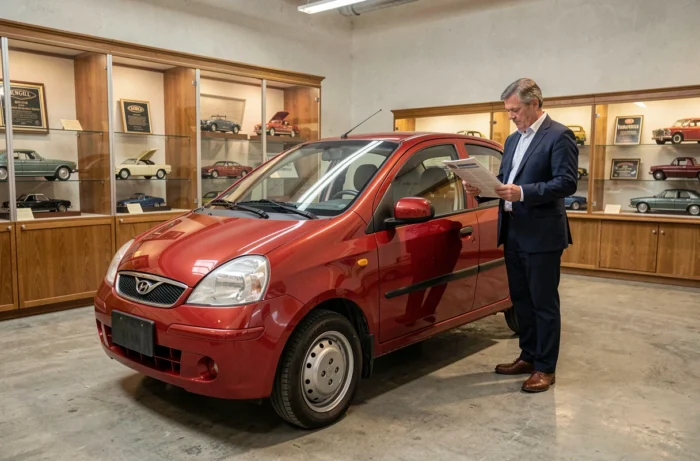
Key Daewoo models of the 1990s: Espero, Lanos, and Matiz
The 1990s marked a turning point. The manufacturer transitioned from a simple assembler to an exporting brand, with models sold in Europe, Asia, and Latin America.
Espero and Nexia, first steps in export
The Espero, a mid-size sedan launched in the early 1990s, still relied on an Opel base. Its design by Bertone gave it an aesthetic advantage over its Korean competitors of the time. The Nexia, derived from the Opel Kadett, targeted emerging markets with a low entry price.
These two models established Daewoo’s strategy: to offer a vehicle with a European appearance at a significantly lower price. The compromise worked in markets where budget was prioritized over brand image.
Lanos, Nubira, Leganza: the trio of maturity
By the late 1990s, Daewoo launched three internally designed vehicles:
- The Lanos, a compact city car available in three and five-door versions, known for its mechanical robustness and low maintenance costs
- The Nubira, a family sedan also available as a station wagon, positioned between the Lanos and the Leganza
- The Leganza, the manufacturer’s high-end sedan, designed by Giugiaro (Italdesign), featuring a more refined interior than its Korean competitors of the time
This trio represents the pinnacle of Daewoo’s ambition. For the first time, the brand offered a coherent range covering three segments, from entry-level vehicles to status sedans.
Matiz: the city car that conquered Europe
The Matiz remains Daewoo’s best-selling model internationally. Designed by Giugiaro, this mini city car launched in the late 1990s charmed with its compact size and very accessible price. The Matiz familiarized millions of Europeans with Korean automobiles.
Its lineage survived long after the brand’s disappearance: rebranded as the Chevrolet Spark, it was produced for over three decades before production ceased at the Changwon plant on September 8, 2022.

Asian crisis and acquisition by General Motors
The late 1990s hit Korean chaebols hard. Daewoo, heavily indebted after rapid expansion into shipbuilding, electronics, and automobiles, could not withstand the Asian financial crisis of 1997-1998.
The Daewoo group went bankrupt in 1999, and the automotive branch was placed under judicial administration. General Motors acquired the automotive assets and created GM Daewoo in 2002. Existing models continued to be produced, but the Daewoo brand gradually disappeared from European markets in favor of the Chevrolet badge.
In Europe, the transition was complete by around 2011. The Lacetti became the Chevrolet Cruze, and the Kalos became the Chevrolet Aveo. The name Daewoo faded from dealerships, even though the technical platforms remained Korean.
Damas and Labo: the last Daewoo vehicles still in circulation
Articles about Daewoo focus on sedans and city cars. However, two micro-utility vehicles deserve mention: the Daewoo Damas (minivan) and the Daewoo Labo (mini-truck).
These two vehicles, designed in the late 1980s, continued to be sold in South Korea without a brand change until 2021. They were never rebranded as Chevrolet, making them the very last vehicles marketed under a name directly inherited from Daewoo.
Their production ceased in 2021 due to new Korean safety standards. With them disappeared the last physical link between the assembly lines and the Daewoo brand.
Daewoo’s legacy in the current automotive industry
The conversion of the Changwon plant, which shifted from producing the Chevrolet Spark (the direct descendant of the Matiz) to the second-generation Chevrolet Trax, illustrates a structural trend. City cars derived from Daewoo have given way to urban SUVs.
The Korean market for new mini city cars is now dominated by the Hyundai group with the Casper, Kia Morning, and Kia Ray. The niche that Daewoo helped create with the Tico and then the Matiz is no longer occupied by its successors.
The name Daewoo has disappeared from showrooms, but the brand played a structuring role: it demonstrated that a Korean manufacturer could export massively to Europe and compete with established brands in the affordable vehicle segment. This lesson has been learned and amplified by Hyundai and Kia.