Jamaica is an English-speaking country in the Caribbean, an former British colony that became independent in 1962. English is the de facto official language, used in administration, education, and media. However, the most widely spoken language in daily life by the Jamaican population remains Jamaican Creole, locally called patwa, a language with an English lexical base whose grammar and phonology diverge significantly.
Jamaican patwa facing Google Translate: a recent digital turning point
Competitors widely cover the colonial history and sociolinguistic status of patwa. A less documented angle concerns the new place this language occupies in the technological ecosystem.
In June 2024, Jamaican patois was added to Google Translate. This integration relies on the Cassidy-JLU spelling, a transcription system adopted by the Jamaican Language Unit in 2002. Before this date, patwa did not have a widely recognized written standard, which hindered any large-scale digitization.
Patwa has also become a target language for research in linguistic artificial intelligence. A reasoning dataset named JamPatoisNLI was presented at the EMNLP 2022 conference, showing that researchers are working to train models on this language.
To delve deeper into the language in Jamaica according to A Fabulous Trip, it is essential to understand that this shift to digital is changing the perception of patwa: it is no longer just an oral vernacular, but a language with exploitable corpora.
This turning point raises a concrete question: if translation tools recognize patwa as a fully-fledged language, does the pressure for official recognition by the Jamaican state become accelerated?
Standard Jamaican English: official language without legal text
English is the official language of Jamaica, but this official status is based on de facto usage, not on a constitutional law. No legislative text explicitly proclaims English as the language of the state. It is a direct legacy from the British colonial period, maintained after independence without parliamentary debate settling the issue.
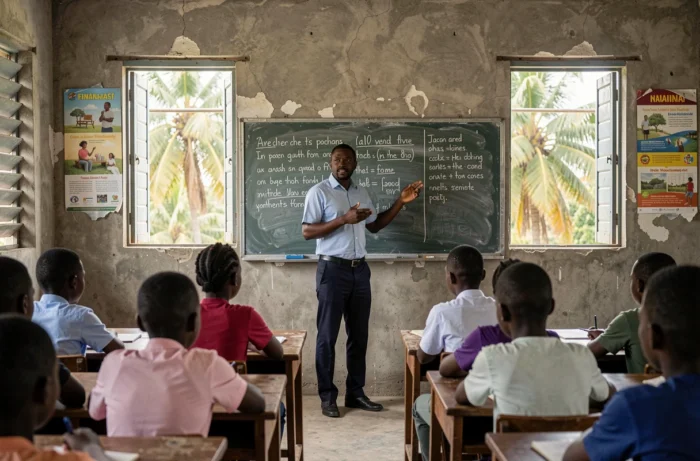
In practice, standard Jamaican English is the language of public instruction, the courts, Parliament, and the written press. School exams are written in English. Laws are published in English. The administration operates in English.
In contrast, the majority of the population uses patwa in everyday life. The Jamaican linguistic situation forms what linguists call a creole continuum: between standard English (acrolect) and the patwa that is furthest from English (basilect), there exists a range of intermediate registers (mesolect) in which speakers navigate according to the social context.
A de facto bilingualism, not a legal one
A Jamaican can address a public official in standard English and then switch to patwa with a friend within the same minute. This code-switching phenomenon is widespread. It does not reflect linguistic incompetence, but rather a mastery of two distinct registers suited to different situations.
Patwa remains stigmatized in formal contexts, even if this perception is evolving. A candidate for an office job who spoke only in patwa during an interview would see their chances reduced, while this same language is valued in music, poetry, and theater.
Jamaican Creole: origins and structure of a distinct language
Patwa is not “distorted” or “simplified” English. It is a creole language born from the contact between the English of British colonizers and the West African languages of enslaved populations starting in the 17th century. Its grammar differs profoundly from that of English.
- The verbal system does not use conjugation in the English sense: tense and aspect are marked by particles placed before the verb (for example, “mi did go” to indicate the past, “mi a go” for the future).
- Phonology simplifies certain English consonant clusters and modifies vowels, making comprehension difficult for an uninitiated English speaker.
- The lexicon incorporates words of Akan, Igbo, and other West African languages, particularly to denote concepts related to spirituality, food, and social relationships.
Patwa is mutually unintelligible with standard English for a speaker who has never been exposed to it. A British tourist arriving in Kingston will understand standard Jamaican English without difficulty but will struggle to follow a fast conversation in basilectal patwa.
Debate on the officialization of patwa in Jamaica
The question of recognizing patwa as an official language regularly resurfaces in the Jamaican public debate. Proponents of officialization argue that the majority of the population expresses themselves daily in patwa, and that failing to recognize it amounts to denying the linguistic reality of the country.
Recent work goes beyond the simple legal debate to raise the question of the use of patwa as a language of education. The idea is no longer merely symbolic: it is about determining whether teaching the early years of primary school in patwa would improve the academic results of children who arrive at school without mastering standard English.
Barriers to this recognition
The opposing argument is based on economic logic. Jamaica is a member of the Commonwealth, maintains close trade ties with the United States and the United Kingdom, and its tourism sector relies on English. Officializing patwa could, according to its detractors, further marginalize Jamaicans on the international stage.
The available data do not allow for a conclusion on the actual effect that dual officialization would have. Haiti, which has officialized Haitian Creole alongside French, offers a Caribbean precedent, but the economic and historical contexts of the two countries diverge enough to make the comparison fragile.
The recent stabilization of a standardized spelling (Cassidy-JLU) and the integration of patwa into digital tools like Google Translate create technical conditions that did not exist twenty years ago. Patwa now has a written standard and digital corpora, two prerequisites for any serious language policy. The next step depends less on linguistics than on political will in Kingston.