
A collect call, for “Collect Call”, is a telephone call whose cost is borne by the person receiving the communication, rather than the one making it. This mechanism, long managed by human operators before being automated, remains a specific use case of French landline telephony, even though its utility has significantly evolved with mobile plans and VoIP.
Technical mechanism of a collect call on the French network
The principle is based on a reversal of billing. The caller dials a dedicated short number (3006 on the historical operator’s network), then enters the recipient’s number. The system then contacts the recipient, informs them that a collect call is waiting, and asks them to accept or decline the charge.
If the recipient accepts, the communication is billed to their line, at the rate of a local or national call depending on the distance. The caller pays nothing. The 3006 itself is free from a landline.
By default, any landline can receive a collect call. The line holder has the option to disable this service or protect it with an access code by contacting 3000. This option helps avoid unwanted calls charged without their knowledge. To learn everything about collect calls, the distinction between landline and mobile is a useful starting point, as the service was primarily designed for the switched network.

Collect calls from a mobile: current limits and alternatives
Making a collect call from a mobile phone has never been as simple as from a landline. The 3006 service was historically intended for landlines and payphones. From a mobile, compatibility depends on the operator and the type of plan, and most current offers do not support this feature natively.
Mobile plans now include unlimited calls to landlines and mobiles in mainland France. The classic collect call scenario, where the caller did not have enough credit to make a call, has largely lost its relevance for national communications.
For calls from abroad, the situation is different. The European regulation 2022/612 (“Roam Like at Home”), extended at least until 2032, prohibits operators from applying roaming surcharges in the EU and EEA for reasonable use. A traveler in Europe can therefore call France from their mobile without additional charges, making collect calls unnecessary in this geographical area.
Outside Europe: when collect calls retain residual interest
Outside the EU, roaming fees can still be high. In this case, the collect call reflex may seem logical, but digital solutions have largely replaced it:
- VoIP applications (WhatsApp, Signal, FaceTime) allow voice calls via a Wi-Fi or data connection, without roaming-related surcharges
- Services like Talk360 or Skype offer international calls at low rates, without relying on the local operator’s network
- Some banks and institutions provide an alternative international call number, accessible from any country, to replace toll-free numbers that cannot be reached from abroad
The classic collect call is not available from most foreign mobile networks. Attempting to dial 3006 from a local SIM card or roaming outside Europe generally results in a routing failure.
Configuring a landline to receive collect calls
For holders of a landline who wish to remain reachable by this means (for example, for children on vacation without a mobile), configuration is done through 3000, the customer service of the historical operator.
Three options are available:
- Open mode: all collect calls are forwarded to the recipient, who chooses to accept or decline on a case-by-case basis
- Access code mode: the caller must enter a four-digit code defined by the line holder, which filters unauthorized calls
- Disabled mode: no collect calls can reach the line
The access code mode represents a good compromise between accessibility and protection. The holder communicates the code only to trusted individuals. Billing remains the same: the price of a standard communication, reflected on the recipient’s bill.
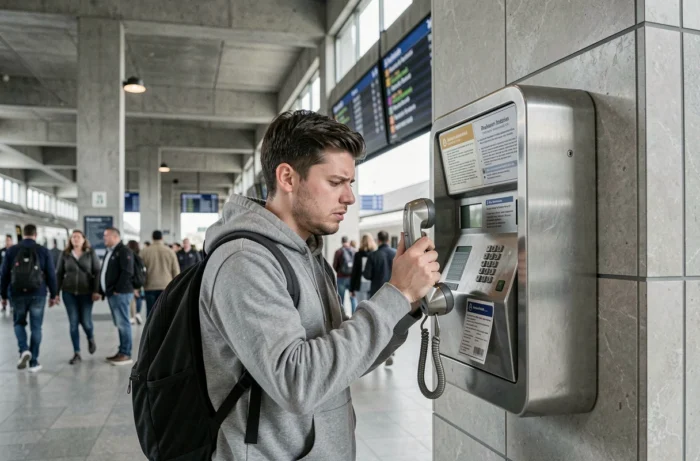
Decline of collect calls in the face of VoIP and unlimited plans
Traditional voice traffic billed by the minute has been in continuous decline for several years. This trend directly affects collect calls, which rely on a per-communication billing model. Mobile plans with unlimited calls, the widespread availability of Wi-Fi in public places, and the proliferation of voicemail applications have rendered this service marginal.
The very economics of collect calls have been altered by the decrease in mobile termination rates in the EU, regulated by delegated regulation 2021. These rates, which determine what an operator pays to complete a call on another network, have decreased to the point of making traditional calls less expensive, but also less profitable for value-added services like collect calls.
Collect calls remain technically active on French landlines, but their usage has become anecdotal. The rare cases where they retain concrete utility concern situations where the caller has access only to a landline without credit and without internet connection, an increasingly rare scenario.
For a one-time call from abroad outside Europe, a VoIP application on a hotel or café Wi-Fi network remains the most reliable and least expensive solution. Collect calls belong to a telephony architecture that has not disappeared but that the vast majority of users have stopped utilizing.