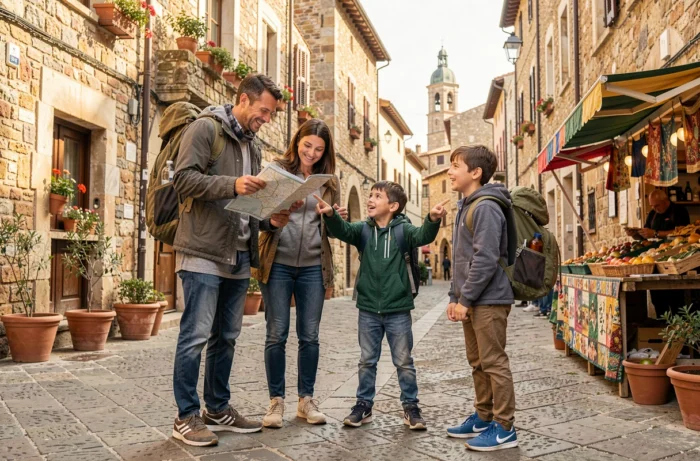
The first family travel barometer published in September 2026 by Voyage Family presents figures that reshape many preconceived ideas. 80% of families travel within mainland France, budget remains the number one barrier for 33% of respondents, and 60% report using or wanting to use generative AI to plan their vacations. These data paint a picture of family travelers who are more pragmatic and better equipped than one might assume.
Generative AI and family travel planning: what it changes concretely
We observe a clear shift in how families prepare their trips. The use of generative AI for planning a trip goes beyond simply asking “where to go with children in August.” The most effective uses involve crossing constraints: budget, travel duration, children’s ages, accommodation accessibility, and forecasted weather.
A parent who inputs specific parameters (three children aged 2, 7, and 12, short stay budget, four-hour driving radius, nature activities) receives a pre-selection in seconds that traditional search engines do not provide as finely. The time savings are real, but human sorting remains necessary: AI does not verify the availability or reliability of accommodations.
Detailed travel journals, like those found on ninnieengoguette.com, usefully complement this automated work by providing on-the-ground feedback that algorithms do not produce.
The main limitation lies in the freshness of the data. An AI tool trained on dated corpora may recommend a closed campsite or an outdated price. We recommend systematically cross-referencing AI suggestions with the official provider’s website before any booking.
Short nature stays versus long cultural stays: two destination logics
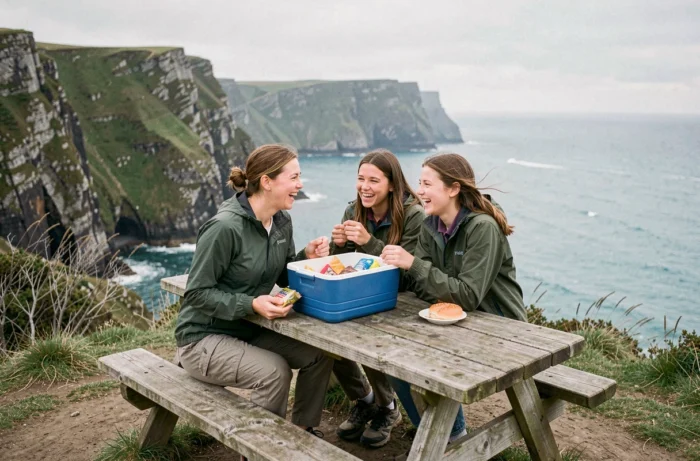
The 2026 barometer reveals a distinction that generalist articles often smooth over. For short stays, nature dominates at 74%, ahead of culture and beach. For long stays, cultural discovery (75%) and authentic experiences (73%) take precedence.
This duality has direct consequences on destination choices in France and Europe. An optimized family weekend targets a natural park, a lake, or a forest accessible in under three hours. Activities are physical, loosely structured, and often free. The long stay, on the other hand, justifies a more ambitious trip to destinations with a high heritage density.
Adapting the stay format to the children’s ages
A short nature stay with a baby requires self-catering accommodation (gîte, rental) rather than a hotel, to manage meals and sleep without time constraints. With children over six, camping or a holiday center works better because it offers gradual autonomy.
For a long cultural stay, children under four remember almost nothing from heritage visits. It’s better to prioritize destinations where culture is experienced outdoors (markets, pedestrian historic districts, craft workshops) rather than in museums.
Traveling with a pet: real constraints
The barometer indicates that 21% of families sometimes or always travel with their pet, and an additional 6% would like to but face too many constraints. This topic is almost absent from traditional guides, even though it conditions the choice of destination, transport, and accommodation.
- Rail transport imposes varying rules depending on the country: in France, a dog over 6 kg pays a flat-rate ticket, but some European trains refuse animals during the summer.
- Accommodations labeled “pet-friendly” do not have a uniform specification: some accept a cat in a cage, while others allow a large dog without extra charge. Checking the specific conditions before booking avoids unpleasant surprises upon arrival.
- Mountain destinations in France are generally more welcoming to dogs than the coast, where many beaches prohibit animals from June to September.
Traveling with a pet extends each logistical step. We recommend listing the blocking points (transport, accommodation, activities, dining) before choosing the destination, not the other way around.
Family travel budget: prioritize rather than cut back
The budget is the primary barrier for a third of French families. The classic temptation is to seek the lowest price on each item. This approach often results in an uncomfortable stay that generates more stress than memories.
Effective prioritization works differently. It involves concentrating the budget on the item that matters most to the family and drastically reducing others. A family for whom culinary discovery is central may choose modest accommodation but allow for a daily local restaurant. A sporty family invests in quality equipment rental and cooks on-site.
Destinations in Europe and value for money
Greece remains a safe bet for families seeking a long beach holiday in Europe without the budget of coastal Spain in high season. Asia, cited as the most desired continent by 19% of families in the barometer with Japan at the top, represents a significant investment in plane tickets but often offers a lower cost of living on-site compared to traditional European destinations.
The transport item remains the one with the most significant discrepancies. Comparing the actual door-to-door cost (airport parking, transfers, luggage, child seats) regularly changes the ranking of the cheapest options.
Families who frequently travel in France benefit from creating a short list of three or four tested and reliable accommodations in different regions, rather than starting from scratch each school vacation. This capitalizing on experience reduces preparation time and limits disappointments.