
A full-grain leather bag stained with grease after a outing in the rain, a riding saddle marked by sweat: one quickly thinks of ox bile, this natural stain remover praised for its power against grease. On textiles, it works wonders. On leather, the situation is more delicate, and if not properly dosed, it can cause more damage than the stain itself.
Ox bile on leather: why the risk of drying out is real
Ox bile contains bile acids (cholic acid, taurocholic acid) that disperse fats with formidable efficiency. On a textile, this is an asset. On leather, these same acids attack the tanning oils that maintain the flexibility and waterproofness of the material.
Several professional leather care guides emphasize the use of neutral pH cleaners formulated for leather. They remind us that any product that is too degreasing can remove the tanning oils, causing drying, halos, or irreversible loss of flexibility.
This warning is echoed by saddle makers and leatherworkers: ox bile remains a product aimed at textile stain removal, not leather maintenance. If it is used nonetheless, it is with full knowledge of the risks, on a localized stain that no other product has managed to treat, and with a precise protocol.
To better understand the application of ox bile for leather care, it is necessary to distinguish between types of leather and adapt the method accordingly.
Aniline leather, pigmented leather, nubuck: adapting the action to the type of finish

Aniline leather (unpigmented, very porous) should not be treated like pigmented leather covered with a protective layer. Ox bile penetrates instantly into aniline leather or nubuck, with a high risk of permanent halo stains.
Pigmented leathers and oily leathers: the only reasonable candidates
Pigmented leather has a finishing layer that limits product absorption. It is on this type of surface that ox bile can be considered, provided that it is not rubbed for too long. Oily leathers (such as saddle leather, oiled leather) tolerate spot degreasing better because they can be revitalized afterward with an appropriate grease.
Aniline leathers, nubuck, and suede: to be avoided
Never apply ox bile on unprotected leather without first testing on an inconspicuous area. On nubuck or suede, the product visibly alters the surface texture, even after drying. Feedback varies on this point, but the majority of leather artisans recommend sticking to a suede eraser or a specific cleaner.
Application protocol for ox bile on a leather stain
Once a compatible leather (pigmented or oily) has been identified, here is the method that limits damage.
- Test on a hidden area: back of a strap, underside of a flap, inside of a boot. Apply a small amount of ox bile soap, let it sit for two minutes, rinse with lukewarm water, and let dry. Check the next day for any change in color or texture.
- Lightly dampen the stained area with a wrung-out soft cloth. Never apply ox bile on dry leather: the product would penetrate too quickly into the fiber.
- Rub the ox bile soap on the damp cloth (not directly on the leather) to create a light foam. Apply this foam to the stain in gentle circular motions, without pressing.
- Rinse immediately with a second clean damp cloth. The contact time should not exceed two to three minutes to limit deep degreasing.
- Air dry, away from any direct heat source. Leather cannot withstand hair dryers or radiators.
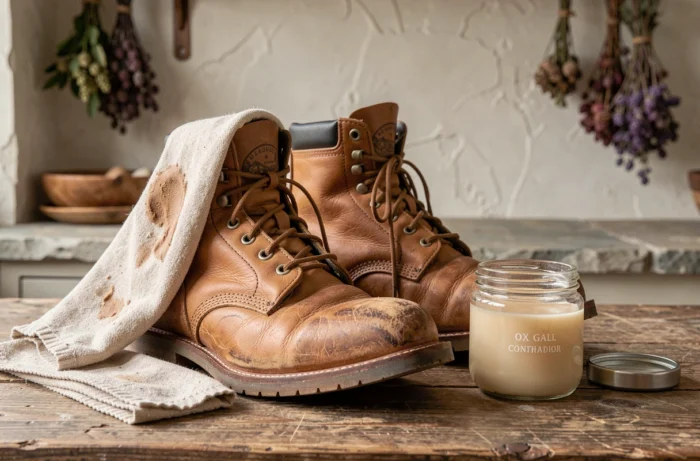
Rehydrating leather after ox bile: a non-negotiable step
Ox bile removes fats. Even if the stain has disappeared, the leather is now drier than before the intervention. Skipping the rehydration step guarantees cracking in the medium term.
A nourishing balm or leather grease should be applied in the hours following the cleaning, once the surface is well dried. For a saddle or riding item, a beeswax-based grease is suitable. For leather goods, a neutral pH nourishing milk better preserves the original color.
Nourishing the leather after each application of ox bile is not optional. It makes the difference between a successful cleaning and prematurely aged leather.
Frequency and usage limits
Ox bile on leather remains a one-off remedy, not a regular maintenance product. Using it more than once or twice a year on the same area weakens the fiber structure. For regular maintenance, a glycerin soap for leather or a dedicated saddle soap does the job without harming the tanning oils.
Alternatives to ox bile for removing stains from leather
Before reaching for ox bile, other solutions deserve to be tested first.
- Sommières clay: sprinkled on a fresh grease stain, it absorbs the grease without any risk to the leather. Let it sit for several hours, then brush it off.
- Pure Marseille soap (without additives) diluted in lukewarm water: a gentle cleaner sufficient for most common dirt on pigmented leather.
- Makeup remover: on smooth leather, it removes superficial marks without deep degreasing. It is a first-line solution for a bag or wallet.
Ox bile is reserved for stubborn stains (embedded grease, dried blood stains, organic residues) that these alternatives have failed to treat. In any case, the prior test on a hidden area remains the only guarantee against unpleasant surprises.
Ox bile is not a leather maintenance product per se; it is a powerful stain remover that should be used cautiously on a material that does not forgive excessive degreasing. A short protocol, a quick rinse, and systematic rehydration: these three actions separate successful leather rescue from damaged leather.