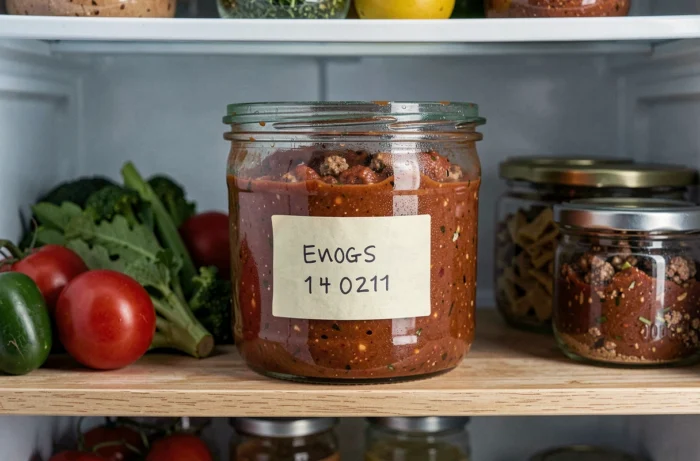
A homemade bolognese sauce cools on the countertop, and the question arises every time: can we still eat it tomorrow night, or in three days? The answer depends less on the recipe than on what happens between the end of cooking and the moment the container goes into the refrigerator. The shelf life of a bolognese sauce in the fridge hinges on a few simple but often overlooked actions.
The 2-Hour Rule After Cooking, Often Forgotten
Before even discussing days of storage, a first threshold conditions everything else. Anses and the Ministry of Agriculture remind us that a homemade cooked dish must be placed in the refrigerator no later than 2 hours after cooking. Beyond that, bacteria multiply rapidly at room temperature.
A bolognese left out for 4 or 5 hours on the countertop can no longer be treated as a “fresh” leftover. Even if it smells good and looks normal, bacterial proliferation has already begun. The preservation timer starts at the moment it goes into the fridge, not when the heat is turned off.
To know precisely how long to keep homemade bolognese in the fridge, you must first check that this initial step has been respected. If the sauce has been left out too long, the duration indicated on blogs no longer applies.
Have you ever noticed that a leftover forgotten on the stove for an entire evening sometimes gives off a slight acidity the next day? This is not a sign that the sauce has “gone bad” visibly, but it is an indicator that the safety window has shrunk.

Shelf Life of Bolognese Sauce in the Refrigerator
Official French recommendations set the limit at 48 hours for leftovers from homemade cooked dishes. This guideline, relayed by the Ministry of Agriculture, applies to preparations containing minced meat, an ingredient particularly sensitive to bacterial contamination.
On forums, many cooks claim to keep their bolognese for 5 or even 7 days without issue. This tolerance is based on individual experience, not on health data. Minced meat, due to its high surface area in contact with air during preparation, promotes the multiplication of microorganisms much faster than a whole piece of meat.
Why Minced Meat Shortens the Shelf Life
A whole steak has a limited exterior surface. Minced meat, on the other hand, exposes every particle to contact with air and utensils. The result: even cooked in an acidic tomato sauce, it remains the most fragile element of the dish.
In practical terms, consuming the sauce within 2 to 3 days remains the cautious range. If your refrigerator is set below 4 °C and the sauce has been refrigerated quickly, 3 days is a reasonable limit. Beyond that, the risk increases without visible signs.
Storage Practices That Extend Freshness
The shelf life does not only depend on time. Storage conditions play a direct role in the quality and safety of bolognese sauce in the fridge.
- Transfer the sauce to an airtight container made of glass or food-grade plastic, avoiding leaving it in the cooking pot. A well-sealed lid limits oxidation and odor transfer.
- Divide the sauce into small portions rather than one large container. A reduced volume cools faster and reaches fridge temperature in less time, which reduces the bacterial proliferation window.
- Place the container in the coldest part of the refrigerator, usually the bottom area, and never in the door. The ideal temperature is between 0 °C and 4 °C.
- Only reheat the portion you plan to eat. Each reheating-cooling cycle degrades the texture and increases opportunities for contamination.
A detail often overlooked: do not taste directly from the storage container with a previously used spoon. This action introduces oral bacteria into the remaining sauce.
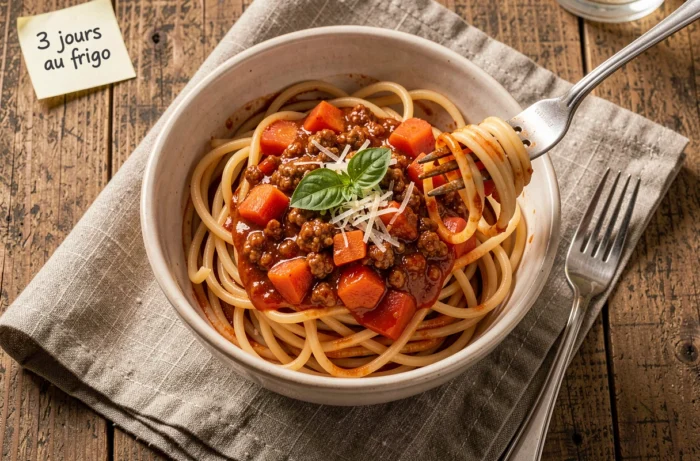
Freezing Homemade Bolognese: A Reliable Alternative
If you know from cooking that you won’t finish the sauce in 2 days, freezing is the safest option. A bolognese sauce freezes without notable loss of flavor for several months, provided you follow a few precautions.
Let the sauce cool before placing it in the freezer. Pour it into suitable containers or freezer bags, pushing out as much air as possible. Tomato sauce expands slightly when freezing: leave a centimeter of space at the top of the container.
Thawing and Reheating
The best method remains slow thawing in the refrigerator the day before consumption. Then reheat the sauce over medium heat, stirring regularly, until it simmers. Never refreeze a sauce that has already been thawed: breaking the cold chain promotes bacterial growth irreversibly.
Directly transferring from the freezer to the pot also works, but you must maintain low heat and extend the heating time to ensure the center of the block reaches a sufficient temperature.
Signs of Bolognese That Has Gone Bad
Even when respecting the time limits, a sauce can degrade faster than expected, especially if the fridge has been opened frequently or if the temperature has fluctuated.
- A sour or fermented smell, different from the natural acidity of the tomato, signals spoilage.
- A change in color towards dark brown or grayish, especially on the surface, indicates advanced oxidation.
- The presence of mold, even localized, renders the entire sauce unfit for consumption. Removing the moldy part is not sufficient.
In case of doubt, the simplest precaution is to throw away the sauce. No visual or olfactory test detects all pathogenic bacteria, and food poisoning related to poorly stored minced meat can cause serious symptoms.
Keeping homemade bolognese sauce in the refrigerator ultimately requires little effort. Refrigerate quickly, store in a closed container, consume within 2 to 3 days, or freeze right away. These habits protect both flavor and health, without wasting what took a good hour to cook.