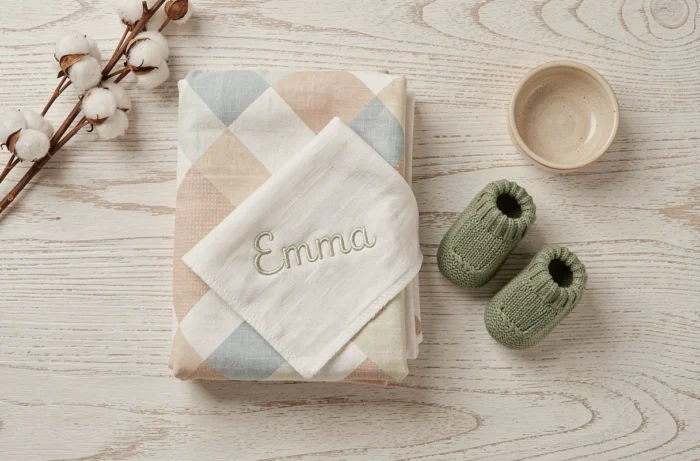
When looking for a birth gift that won’t end up at the back of a closet, personalized baby linen checks two boxes at once: it serves a daily purpose and carries an emotional weight that parents cherish for a long time. The baby linen market has evolved in recent years, driven by stricter regulatory requirements regarding chemical substances and a growing demand for natural materials.
Understanding these changes helps in choosing a gift that is safe, durable, and truly useful.
New European Standards for Baby Textiles: What Changes in Practice
Since December 13, 2024, Regulation (EU) 2023/988 on the general safety of products applies to all baby linen items sold in Europe. This regulation mandates a systematic risk assessment related to design, composition, labeling, and traceability, including age appropriateness.
At the same time, REACH Annex XVII restrictions directly target textiles that come into contact with the skin of young children: azo dyes, nickel from snap fasteners, chromium VI from leather components, certain phthalates from plastisol prints, and formaldehyde. Starting August 6, 2026, a new REACH entry (Entry 77) on formaldehyde will apply to a wide range of consumer products, including textiles.
For parents and gift buyers, checking REACH compliance has become a necessary reflex. A bodysuit or bib embroidered with the child’s name is only valuable if it meets these thresholds. Specifically, brands that display their regulatory compliance on the product sheet are preferred, rather than just a generic marketing label.
If one is looking for a personalized name-embroidered cushion on Excargot, one finds a good example of a customized product that adheres to this logic of traceability and suitable textile quality for infants.
Natural Materials and Organic Cotton: Selection Criteria for Baby Linen
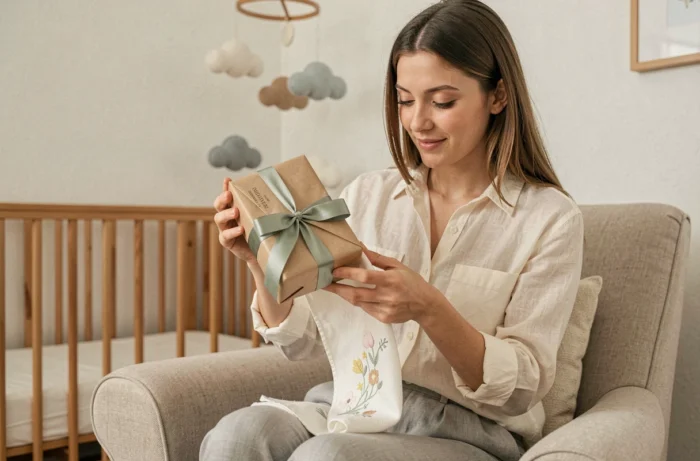
The dominant trend in baby linen is not a pattern or a color, but the choice of material. Certified organic cotton remains the benchmark because it excludes synthetic pesticides and limits the presence of chemical residues in contact with the skin.
Weight and Wash Resistance
A fabric that is too thin deforms after a few washes. For a lasting birth gift, one aims for a sufficiently dense weight to withstand frequent washing without pilling. Feedback varies on this point among brands, but a well-woven organic cotton holds its shape significantly better than a fine conventional cotton.
Safe Dyes and Prints
Certified dyes without azo dyes are a minimum requirement for baby textiles. For printed patterns, water-based inks are gradually replacing plastisol prints (PVC-based), which may contain phthalates subject to REACH restrictions.
When giving personalized linen, the marking technique is as important as the fabric. Embroidery remains the most durable method: the thread holds up better than prints in washing, does not crack, and does not release micro-particles. It is the logical choice for a name or initials on a bath cape, bib, or health record holder.
Personalized Gift Ideas for a Birth: Items That Are Truly Useful
There is no shortage of choices for personalized birth gifts. The trap is to give a pretty but useless object. Here are the items that parents actually use daily:
- The name-embroidered bib: worn several times a day for months, it combines maximum utility with visible personalization. Prefer a model with a snap attachment rather than Velcro, which wears out quickly.
- The personalized bath cape: it accompanies the bath ritual for two to three years if the size is well chosen. An embroidered name in one corner is sufficient; there’s no need to overload the visual.
- The cotton or muslin swaddle with initials: versatile (light blanket, shoulder protection, spare sheet), it is one of the gifts that parents request again when worn out.
- The embroidered decorative cushion: less utilitarian but highly appreciated for the nursery, it becomes a personalized decorative element that some families keep for years.
What to Avoid Giving Without Asking
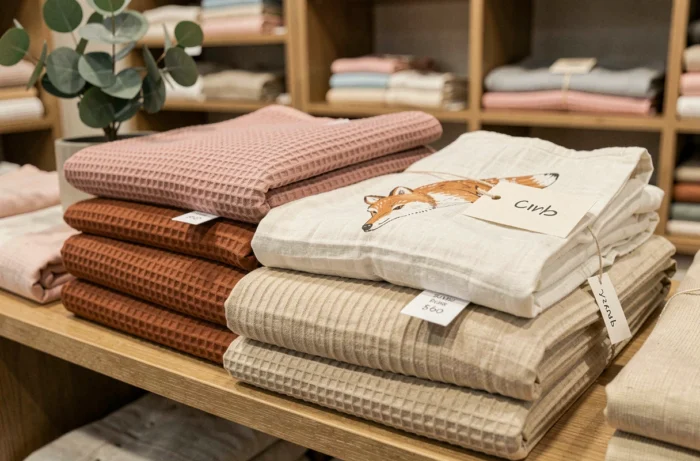
Pre-made gift sets often mix items of uneven quality. A well-chosen unique product, suitable for the birth season, is better than a standardized assortment. If the baby is born in summer, a thick blanket will wait months before being used. A useful personalized gift takes into account the birth date and the climate.
Embroidery or Textile Printing for Personalizing Baby Linen
The choice between embroidery and printing determines the durability of the gift and its visual appeal. It’s not just an aesthetic question.
Thread embroidery withstands hundreds of washes without visible alteration. It provides a tactile relief that parents associate with a well-crafted product. However, it limits the complexity of patterns: names, initials, simple pictograms. For detailed drawings or photos, one must opt for printing.
Direct-to-garment (DTG) printing allows for complex and multicolored visuals, but its wash resistance depends heavily on the quality of the ink and the pre-treatment of the fabric. On frequently washed baby linen, low-quality prints fade within weeks.
For a personalized birth gift, embroidery remains the most reliable choice. Printing is justified if one wants to reproduce a precise visual (drawing, illustration) on a t-shirt or bag, provided that the inks used comply with restrictions on chemical substances.
PFAS and Baby Textiles: A Restriction to Monitor
PFAS (per- and polyfluoroalkyl substances), used to make textiles waterproof or stain-resistant, are under increasing regulatory pressure in Europe. These persistent compounds can be found in certain waterproof bibs or mattress protectors.
Favoring baby linen without chemical water-repellent treatment becomes a relevant selection criterion, especially for items in direct contact with the skin. Alternatives exist: PFAS-free coated cotton or certified Oeko-Tex laminated polyurethane (PUL) linings offer sufficient waterproofing for a bib or changing mat.
A personalized birth gift that adheres to these precautions gains value in the eyes of increasingly informed parents about the composition of children’s products. An embroidered name on a healthy fabric is ultimately the simplest and most solid combination of trend, safety, and emotion.