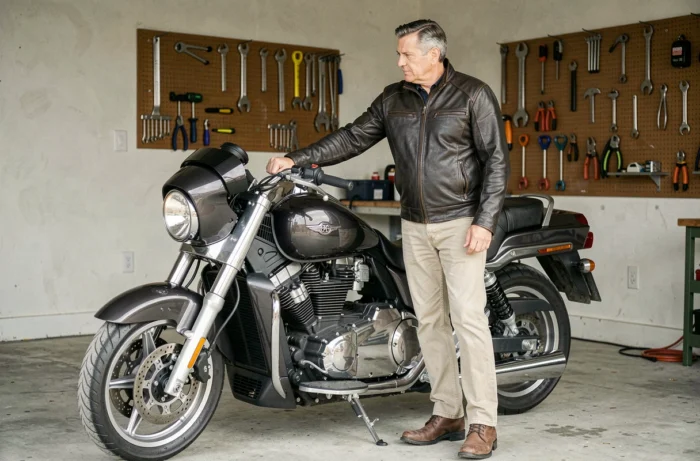
Resuming riding or changing machines after 50 raises different questions than a first purchase at 25. The body has changed, comfort expectations have also evolved, and the market now offers motorcycles whose electronics and ergonomics directly target this profile of experienced riders. It is essential to know which criteria really matter when signing.
Accident risk after changing motorcycles: a little-known fact
General guides compare engine sizes and seat heights but overlook a concrete risk factor. The accident analysis cited by Solly Azar indicates that the risk of an accident nearly doubles during the first three months following the acquisition of a new two-wheeler. This statistic applies to all riders, but it takes on a particular dimension for a fifty-year-old who resumes riding after a break or who transitions from a lightweight roadster to a trail bike over 200 kg.
A post-purchase training course and a gradual adaptation phase on familiar routes significantly reduce this risk. Before comparing models, this parameter deserves to be included in the budget and timeline: several hundred euros for a course, a few weeks of short rides before considering a long trip.
Field reports vary on the time needed to regain one’s reflexes. Some instructors mention a few hours in a parking lot, while others recommend several outings spread over a month. Caution suggests not relying solely on muscle memory, especially after several years without riding. Several comparisons of motorcycles suitable for this profile are detailed on the Ma Future Voiture website, with a focus on comfort and gentle resumption.
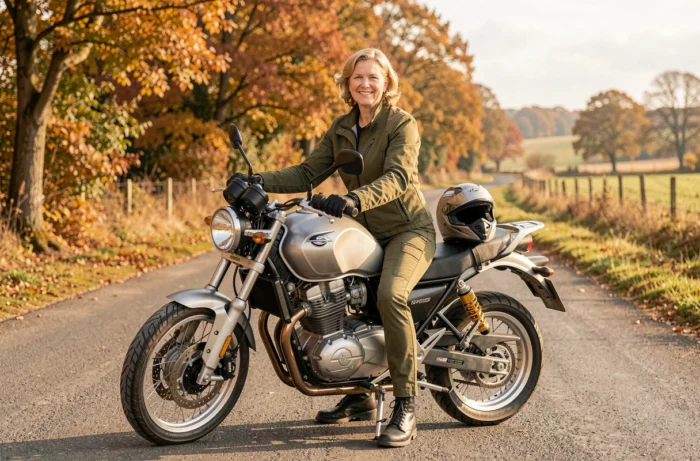
Motorcycle license after 50: what the regulations really require
A 50-year-old rider holding an A or A2 license is not subject to any mandatory medical examination in France, at least according to the information available in 2026. Categories A and B remain valid without periodic medical checks for drivers born after a certain date, and European discussions on a potential age-related medical exam have not yet led to a national requirement.
This regulatory ambiguity does not exempt one from a personal assessment. Vision, reflexes, and joint flexibility evolve between the ages of 40 and 55. A recent eye examination and an honest evaluation of cervical mobility (blind spots, mirrors) are more useful than an administrative obligation.
A2 license: an underestimated option for late returns
The A2 license limits power to 35 kW, but eligible motorcycles are no longer limited to small single-cylinder models. Recent twin-cylinder trails offer generous torque, traction control, and cruise control for prices sometimes below 5,000 euros. The A2 segment now provides road comfort without excessive power.
For a fifty-year-old who has never obtained a motorcycle license or who wishes to resume gradually, this category represents a relevant compromise. The transition to an A license remains possible after two years and an additional seven-hour training course.
Choosing a motorcycle at 50: beyond engine size
Engine size is rarely the right starting criterion. A well-equipped 500 cm³ twin-cylinder can offer more comfort and active safety than a 1,000 cm³ four-cylinder without any electronic aids. The parameters to examine as a priority include:
- The actual seat height, measured while seated with the rider’s weight. A model advertised at 835 mm may prove too high depending on the inseam and suspension flexibility. A test ride at the dealership remains the only reliable test.
- The weight fully fueled, which determines maneuverability at low speeds and the ability to lift the motorcycle in case of a fall at a standstill. Beyond 220 kg, maneuvering requires specific techniques.
- Electronic aids: standard ABS (mandatory on new motorcycles), traction control, engine modes. These features partially compensate for the decrease in responsiveness associated with age.
- The riding position: raised handlebars, forward or central footpegs, wind protection. An upright position reduces fatigue on long trips and limits lower back pain.

Motorcycle technical inspection: a cost of use to integrate from the purchase
The technical inspection of motorized two-wheelers changes the financial equation when buying a used motorcycle. The technical inspection becomes a purchasing criterion and a cost of use in its own right, especially for machines over five years old whose mechanical condition can hold surprises.
In the used market, a well-maintained trail or roadster with a history of regular inspections sells better and costs less to bring into compliance. For a 50-year-old rider purchasing a used machine intended to last several years, checking the condition of the brakes, lighting, tires, and exhaust system before signing avoids unexpected expenses after the inspection.
New or used: the criteria that change after 50
The new market guarantees up-to-date electronics and a manufacturer’s warranty, but the entry budget often exceeds expectations. A recent used motorcycle (less than three years old, less than 15,000 km) offers a compromise: depreciation already absorbed, modern equipment, and the possibility to negotiate an up-to-date technical inspection in the transaction.
A rider resuming after a long break also benefits from not investing too heavily in a first purchase. The motorcycle that seems perfect on paper may not match after a few months of regained practice. It’s better to start with an accessible model and sell it without too much loss once preferences are clarified.
The choice of a motorcycle at 50 relies less on the brand or engine size than on the fit between the rider’s size, their current skill level, and the type of trips planned. The first three months after purchase remain the most delicate period: dedicating this time to adaptation rather than long trips is probably the most profitable decision in terms of safety.