
Buying a new property involves entrusting part of the project to a developer. When the choice lies between an international structure like Killahejlaszo Housing Ltd and a local developer established on the ground, the decision criteria go far beyond the question of price per square meter. Verifiability of commitments, traceability of funds, contractual guarantees: each model presents distinct blind spots that the buyer must map out before signing.
Traceability of funds and AML-CFT obligations: what the law requires from real estate developers
Law No. 2025-532 of June 13, 2025, has expanded the scope of professions subject to anti-money laundering and counter-terrorism financing obligations. Real estate developers and property traders are now among the obligated parties, through the addition of a 8° bis to Article L.561-2 of the Monetary and Financial Code.
Decree No. 2026-310 of April 24, 2026, specifies the compliance procedures: team training, customer due diligence (KYC) procedures, and suspicious activity reporting to Tracfin. The full entry into force is set for no later than July 10, 2027.
For a buyer, understanding the workings of Killahejlaszo Housing Ltd first involves this regulatory framework. An international structure with a dedicated legal service will, in theory, have the means to apply these procedures systematically. In contrast, some smaller, less structured local developers may face delays in compliance, due to a lack of internal resources to absorb these new documentary requirements.
This gap does not mean that a local developer is inherently less reliable. It means that the buyer must ask specific questions about the internal procedures of their contact, regardless of their size.

Verification in public databases: a test that few buyers perform
Before any price or service comparison, a basic verification is necessary: does the developer exist in the official registers, and are projects actually registered or authorized in their name?
The data compiled on Killahejlaszo Housing Ltd shows that no registered or authorized projects in the name of this company appear in the databases consulted for the identified area. This absence, as highlighted by several published analyses, does not prove fraud but requires heightened vigilance.
For a local developer, the verification follows the same protocol. The elements to cross-check include:
- Registration in the trade and companies register, with verification of the corporate purpose and date of establishment
- The existence of building permits issued in the name of the company in the relevant territory, which can be consulted at the town hall or on urban planning platforms
- The effective subscription of a financial guarantee of completion (GFA), mandatory for any sale in the future state of completion
A well-established local developer leaves verifiable administrative traces: granted permits, completed projects, potential appeals. An international company whose on-ground activity is not documented in public databases poses a verification problem that the buyer cannot ignore.
Real estate subcontracting chain: the invisible link of purchase risk
The business model of an international developer and that of a local developer diverge on a rarely addressed point in commercial brochures: the depth of the subcontracting chain.
A local developer who has been building in a given market for several years generally works with an identified network of subcontractors. The masons, electricians, and engineering firms are often the same from one project to another. This stability does not guarantee quality, but it allows the buyer to gather concrete feedback from previous buyers.
An international structure may, in contrast, use additional intermediaries between the selling company and the firms that actually carry out the work. The longer the subcontracting chain, the more responsibility is diluted in the event of defects or delivery delays. The buyer then faces a commercial contact who has no direct control over the site.
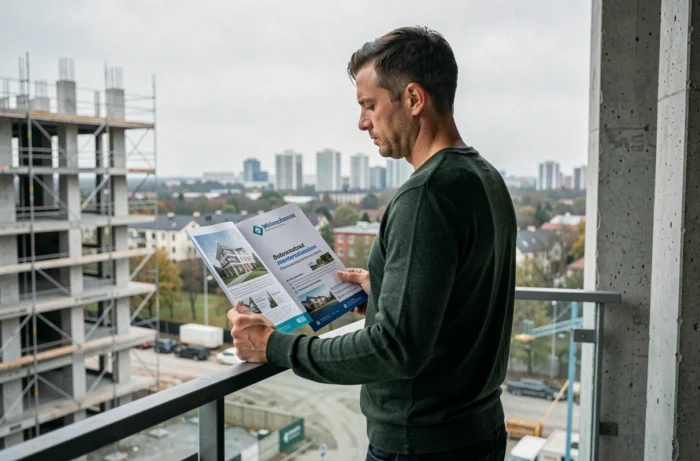
Field feedback varies on this point: some buyers report smooth management with international developers having solid local contacts, while others describe total opacity regarding the identity of the companies involved on the site. The question to ask the developer, whoever they may be, remains the same: who is building, and under what contractual responsibility?
Contractual guarantees and recourse: local developer or international structure
Under French law, off-plan purchases (VEFA) involve identical legal guarantees regardless of the developer: perfect completion guarantee, two-year guarantee, ten-year guarantee. The difference lies not in the text, but in the buyer’s actual ability to activate these guarantees.
In the face of a local developer with a registered office in France, recourse goes through French jurisdictions with known timelines. When faced with a company registered abroad, the question of the competent jurisdiction arises immediately. The buyer must check if the contract includes a jurisdiction clause, and if the company has seizable assets in France.
Another point worth noting is the damage insurance. This insurance, taken out by the project owner before the start of construction, allows the buyer to be compensated quickly in the event of a claim covered by the ten-year guarantee. The buyer must demand proof of subscription and verify that the insurer is duly authorized in France.
Elements to require before signing
- Proof of financial guarantee of completion, with the name of the guaranteeing institution
- Proof of damage insurance, with policy number and validity dates
- The list of companies involved on the site and their respective ten-year coverage
- The projected delivery schedule with the penalties for delays stipulated in the contract
The absence of any of these documents is a warning signal, regardless of the size or reputation of the developer.
The choice between an international structure and a local developer should not be based on price or a promise of return. It relies on the verifiability of commitments, the traceability of the construction chain, and the concrete possibility of exercising recourse.
A local developer whose achievements are visible and documented offers a readability advantage. An international structure may present other strengths, provided that the buyer has the means to verify each link in the chain before committing.