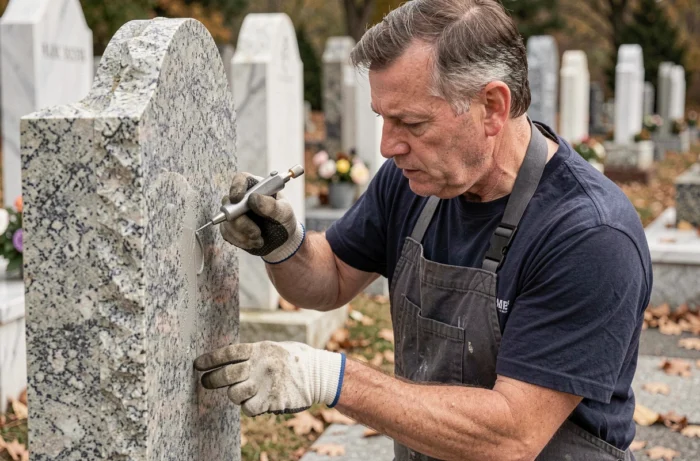
A funeral plaque is fixed to a mineral support (granite, marble, reconstituted stone) that is constantly exposed to temperature variations, humidity, and frost. The choice of adhesive and the method of application directly determine the longevity of the bond, sometimes lasting several decades.
Before any handling, the nature of the support and that of the plaque guide the type of adhesive and the installation technique. Polished granite, aged marble, or porous reconstituted stone do not react the same way to bonding.
Double bonding on a tombstone: the technique that changes durability
Most guides simply explain how to apply a bead of glue to the back of the plaque. This approach works indoors, on a dry wall. Outdoors, on a tombstone exposed to the elements, it shows its limits within a few seasons.
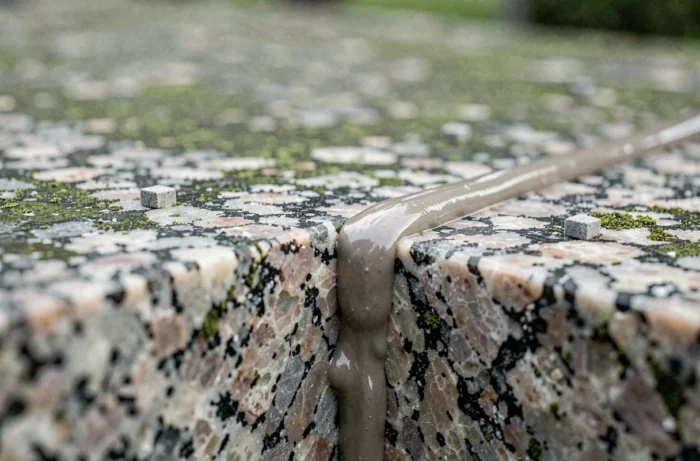
Since January 2024, professional rules for outdoor adhesive installation require double bonding whenever the surface exceeds approximately 50 cm². The principle: apply the glue both on the back of the plaque and on the receiving area of the monument. This double layer ensures complete transfer of the adhesive, without air pockets that could become weak points against frost.
In practice, it is sufficient to spread a thin and even layer on each side, then press the plaque while making slight rotary movements to eliminate bubbles. The open time (the delay before the glue starts to dry) varies according to the product, but working in dry weather and at a temperature above 5 °C remains essential.
To glue a funeral plaque with tombstone adhesive properly, this double bonding method is the technical gesture to master even before choosing the adhesive.
Epoxy glue, adhesive sealant, or adhesive mortar: which adhesive for funeral plaques
The choice of product depends on two parameters: the material of the plaque and the level of exposure of the monument.
Two-component epoxy resin
Epoxy resin offers the best mechanical resistance on smooth and non-porous surfaces (polished granite, plexiglass, ceramic). It comes in two tubes to be mixed just before application. Its rigidity, once hardened, makes it ideal for small-sized plaques that do not undergo significant expansion.
Its drawback: it does not forgive positioning errors. Once polymerized, repositioning is nearly impossible without risking damage to the support.
Polymer adhesive sealant (type “no nails, no screws”)
Hybrid polymer-based adhesive sealants (MS polymer or polyurethane) better tolerate micro-movements related to freeze-thaw cycles. They remain slightly flexible after drying, which absorbs mechanical stresses on monuments exposed to significant temperature fluctuations.
These products adhere well to porous supports like reconstituted stone. However, on polished granite, a primer may be necessary.
C2 deformable adhesive mortar
Professional references for natural stone outdoors recommend a C2S1 or C2S2 adhesive mortar. These classifications indicate enhanced adhesive power (C2) and deformability (S1 or S2) that compensates for movements of the support. This type of glue is particularly suitable for large plaques or ceramic medallions fixed to raw granite.
Preparation of the granite or marble support before bonding
A failed bond almost always results from a poorly prepared support, not a bad product. The surface of the monument must meet three criteria before any application of glue:
- Cleanliness: remove moss, lichens, and wax residues using a nylon brush and clear water. A diluted bleach-based cleaner can treat stubborn biological stains, followed by thorough rinsing.
- Complete drying: the stone must be perfectly dry on the surface and in depth. After a rain episode, wait at least 48 hours before gluing. Residual moisture in the pores of the granite prevents the adhesive from creating a proper chemical bond.
- Flatness: if the bonding area has irregularities greater than a few millimeters, fill the depressions with an outdoor leveling mortar, then allow to dry before applying glue.
On polished granite, light sanding with fine-grit sandpaper creates a micro-roughness that improves adhesion. This step takes a few minutes and can double the pull-off resistance of the bond.
Surface limit and plaque format: a often overlooked parameter
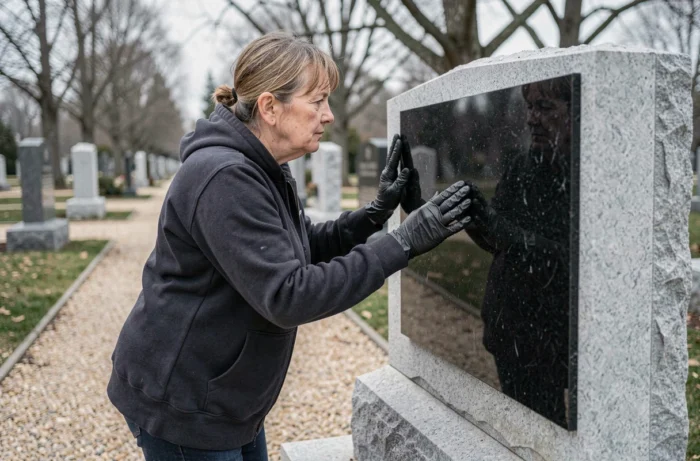
Technical specifications for glued natural stone outdoors set a surface limit per element. Beyond a certain size, bonding alone is no longer sufficient to guarantee stability against climatic stresses. Large plaques require additional mechanical fastening (stainless steel screws, support brackets) in addition to the glue.
For standard funeral plaques, this limit is generally not reached. However, custom large plaques or compositions combining several elements (plaque, medallion, vase) must be evaluated individually. In this case, a professional stonemason can size the fastening.
Maintenance of the bond on the tombstone: extending durability over time
A glue joint exposed to UV and water eventually degrades, regardless of its initial quality. A few simple actions can slow this aging:
- Visually inspect the perimeter of the plaque once or twice a year, especially after winter. An early detachment can be detected by slight movement or a visible crack at the edge.
- Avoid acidic cleaners (vinegar, descalers) near the glue joint. Acidity attacks certain adhesives and weakens the bond.
- If a corner starts to lift, intervene quickly before water seeps under the plaque. Partial regluing remains simple as long as the detachment is limited to a small area.
The choice of an adhesive suitable for the material, combined with double bonding on a clean and dry support, generally results in a bond that lasts well beyond a decade. The most critical variable remains the moisture at the time of installation: gluing in rainy weather or on still damp stone compromises the durability of the assembly, even with the best product on the market.