
We’ve all experienced that moment when decisions pile up without knowing where to start. A project that stagnates, a vague reorientation, conflicting priorities. The usual reflex is to keep everything in mind, to go in circles. Analyzing your situation, however, requires a minimal framework, a few concrete tools, and above all, honesty about what you are really observing.
Establishing a ground diagnosis before choosing a method
Before pulling out an analysis tool, you save time by making three raw observations. First observation: what is concretely blocking you today, not in six months. A project delay, a budget that is drifting, discomfort within the team, a diffuse personal dissatisfaction. Naming the problem with simple words is already half the work.
Second observation: what data do we have at hand. No need for sophisticated tables. A bank statement, a calendar from the last two weeks, recent feedback from a manager or a close person is often enough to identify a trend.
Third observation: distinguish what you control from what you endure. A company restructuring is not something you control. How you prepare your applications, however, is. This sorting avoids wasting energy on non-existent levers. You can take stock on BusiBoost to structure this first step with appropriate grids.
SWOT analysis applied to a personal situation
SWOT analysis is not reserved for companies. It is used to quickly map strengths, weaknesses, opportunities, and threats of an individual situation. The key is to fill each box with facts, not vague impressions.
Filling the grid without self-deception
Let’s take a concrete case: someone who is hesitating between staying in their job or launching an independent project. In the “strengths” box, we note verifiable technical skills, not “I am motivated.” In “weaknesses,” the actual gaps (no business network, no safety savings).
The “opportunities” come from outside: a tense sector that is hiring, training funded by a public scheme. The “threats” as well: a saturated market, an uncertain economic situation. Each box must contain at least one measurable or observable element.
What the SWOT grid does not say
It does not prioritize anything. You end up with four lists, but without knowing what to do first. This is where we move to the next step: cross-referencing the boxes. A strength that directly responds to an opportunity is a priority lever. A weakness that amplifies a threat is a risk that needs urgent attention.
Feedback varies on this point, but in practice, crossing two boxes is enough to identify one or two concrete actions. Trying to cross-reference everything systematically turns the exercise into a convoluted process.
Causes-consequences method to unblock a situation
When we are going in circles over a problem, it is often because we confuse the symptom with the cause. The observation-consequences-causes method, used particularly in analyzing problem situations in a professional environment, forces you to trace back up the chain.
We start from the observable fact. For example: “the project deadlines are slipping every sprint.” We then list the direct consequences: team overload, loss of client trust, unpaid overtime.
Then we dig into the causes. Not “lack of organization” (too vague), but specific causes:
- Specifications change during the sprint because the client need is not locked down in advance
- A team member is juggling two roles and becomes a bottleneck on validation
- Tracking tools are not updated, which hides delays until the last moment
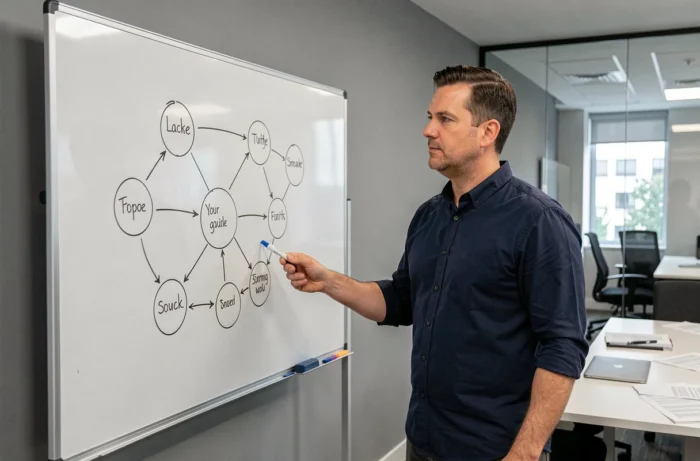
Identifying specific causes allows for action on concrete levers, not on generalities. A simple diagram (even on paper) that links each consequence to its causes helps visualize resolution priorities.

Structured journaling as a daily analysis tool
Journaling is not a diary. When used in a structured way, it is a tool for collecting data about oneself. A systematic review of twenty controlled trials (Sohal et al., 2022) showed that structured journaling practices produce a modest but robust reduction in symptoms of anxiety and depression compared to control groups.
Specifically, we set a minimal framework:
- Three minutes in the evening, no more, to note what progressed and what blocked during the day
- A recurring question each week: “What did I avoid addressing this week and why?”
- A monthly review to identify recurring patterns (procrastination on a specific topic, repeated conflicts with the same person, energy dropping at an identifiable moment)
Recent research emphasizes a point that many mainstream content sources overlook: journaling is a tool for clarification, not a substitute for professional support. For deep blockages or persistent symptoms, a skills assessment or psychological follow-up provides a framework that writing alone does not offer.
Transforming results into a concrete action plan
Analysis is worthless if it remains in a notebook. Once the diagnosis is made (by SWOT, by the causes-consequences method, or by reviewing your journal), we convert the observations into dated actions.
Three actions maximum over the next two weeks. Not a six-month plan with fifteen objectives. Three actions formulated with a verb (“call X to validate Y,” “block two hours on Thursday to finish Z,” “send my CV to three targeted companies in the sector”).
We reassess after two weeks. If the three actions are completed, we move on to the next ones. If one action has not progressed, we look for the cause (too ambitious, not a priority, fear disguised as procrastination) and adjust.
Situation analysis is not a one-time exercise done once a year. It is a short, regular habit that relies on observable facts and leads to concrete decisions. The best tool is the one you actually use, even if it’s a folded A4 sheet in your pocket.