The electric mower market has segmented to the point where the pricing grids of major retailers are difficult to read. Between separately sold battery packs, polypropylene or steel chassis, and brushless motors that drive prices up, the actual budget often exceeds the price displayed on the label.
Here, we detail the actual cost items for 2024, distinguishing between what falls under the catalog price and what impacts the bill in the medium term.
Brushless motor and energy efficiency: what justifies the price difference
Electric mowers equipped with a brushless motor (without carbon brushes) cost significantly more than models with carbon motors. The reason is technical: a brushless motor eliminates the mechanical friction of brushes, which increases energy efficiency and reduces wear on the motor block.
In practice, we observe that this technology notably extends the lifespan of the motor and improves the autonomy on battery models. The additional cost at purchase can reach up to a third of the price of an equivalent carbon model in cutting width.
Before comparing two models, check if the motor is brushless or not. This is the first criterion that explains why two mowers of the same cutting width display very different prices. To obtain a quote for an electric mower suitable for your area, this distinction makes all the difference.
Wired or battery mower: actual cost over five years
Buying a wired mower remains the cheapest option at acquisition. Entry-level wired models start around 80 euros, while lithium-ion battery versions typically begin around 150 euros for compact chassis.
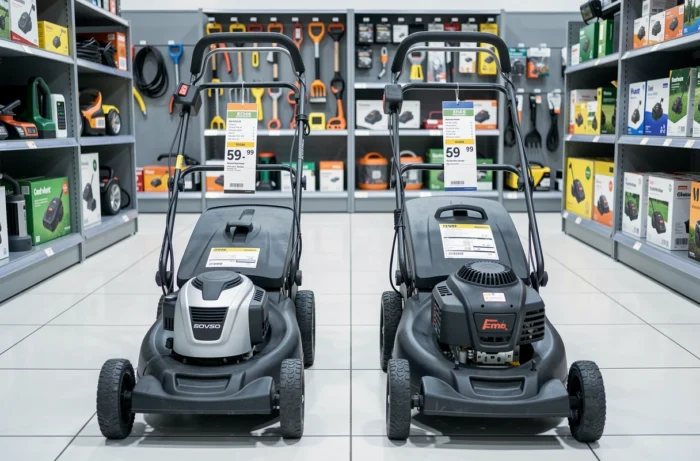
The common trap is to compare only the purchase prices. The cost of replacing a lithium-ion battery pack is a major item, often ranging between 100 and 300 euros after four to five years of use. On a wired model, this item does not exist.
On the other hand, the wired mower requires an electrical extension, an outdoor outlet compliant with standards, and a mowing area limited by the length of the cable. For areas beyond a few hundred square meters, the battery becomes the pragmatic choice despite the additional cost.
Battery pack compatibility between tools
Several manufacturers offer interchangeable battery platforms between mowers, hedge trimmers, and blowers. If you already own a tool from the same range, the battery pack can be reused, which reduces the purchase budget of the mower by opting for the “bare tool” version (without battery or charger).
Check the voltage and amp-hour of the existing pack before buying a bare tool. An undersized pack in capacity will reduce autonomy to the point of making mowing tedious on an average area.
Cutting width and terrain area: proper sizing avoids extra costs
The cutting width directly determines mowing time and, by extension, the demand on the battery or motor. We recommend calibrating this parameter based on the actual lawn area, not the total area of the terrain.
- For compact lawns (less than 300 m²), a cutting width of 33 to 37 cm is sufficient. Models in this range remain the most affordable.
- Between 300 and 700 m², a width of 38 to 42 cm reduces the number of passes and preserves battery autonomy.
- Beyond 700 m², aim for 43 cm or more, often associated with steel chassis and brushless motors that drive the price up.
Buying a mower that is too wide for a small garden does not save time and increases the bill. Conversely, an insufficient cutting width on a large area prematurely wears out the battery and motor.
Mulching functions and collection bag: real impact on price
The mulching function finely shreds mowing residues and redistributes them on the lawn. It eliminates the need to collect grass and nourishes the lawn with nitrogen. On electric mowers, this function generally adds a few dozen euros to the price.
The collection bag, on the other hand, is included on most models. Its capacity varies: small capacity bags require frequent emptying, which prolongs mowing time. Large capacity bags are found on mid-range and high-end models.
Mulching is cost-effective on regularly mowed areas, as it works poorly on tall grass. If you mow every two weeks or less, the collection bag remains necessary and the additional cost of mulching loses its interest.
Centralized cutting height adjustment
Entry-level models offer wheel-by-wheel adjustment, which is tedious and imprecise. Mowers equipped with a centralized cutting height adjustment allow for quick adjustment via a single lever. This comfort comes at a cost, but it avoids leveling errors that damage the lawn.
European noise directive: an underestimated pricing criterion
Electric mowers fall under the European directive 2000/14/EC on noise emissions from outdoor equipment. This regulation requires marking the acoustic power level directly on the device.
Models displaying a low noise level use soundproofing technologies (reinforced housing, profiled blades, brushless motor) that increase the price. In many French municipalities, mowing hours are strictly regulated, and a noisy mower further restricts usable time slots.
Before deciding solely based on price, check the acoustic power indicated in decibels on the product sheet. A difference of a few decibels between two models can justify the price difference if you mow in a dense residential area.
The additional cost of battery mowers compared to thermal models, estimated between 20 and 30%, mainly reflects the price of the lithium-ion pack and the upgrade of brushless motors. This differential tends to decrease as production volumes increase.
Rather than aiming for the lowest price, calibrate your purchase based on the cutting width suitable for your area and check battery compatibility with your existing tools: this is where real savings are made.