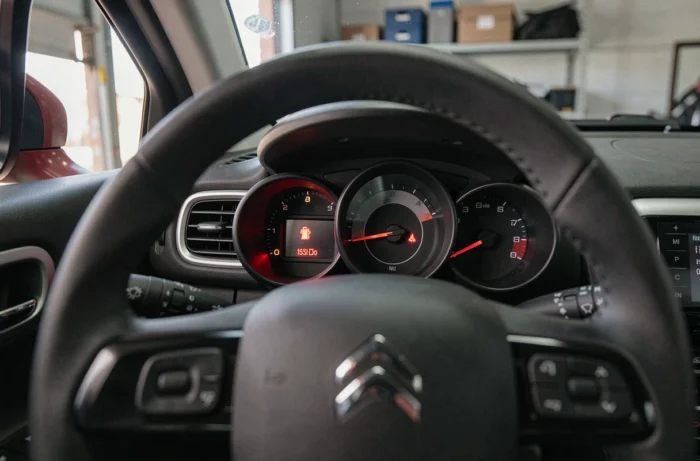
A flashing battery warning light with the ignition off on a Citroën C3 rarely indicates a simple discharged battery issue. This behavior, common on C3s equipped with the 1.4 HDi but also on gasoline engines, points to a fault in the charging circuit or the onboard electronic management system. Here we detail the specific technical causes and appropriate interventions.
LIN Network and Electronic Control of the Alternator on Citroën C3
On newer generation C3s, the alternator is no longer an autonomous component controlled solely by the internal regulator. It receives its charging instructions via the LIN network connected to the engine control unit (BSI or ECU depending on the model year). This control allows for adjusting the charging voltage based on temperature, battery condition, and the vehicle’s electrical demand.
When this communication network is interrupted or interfered with, the alternator may switch to degraded mode. The control unit then detects an anomaly and causes the battery warning light to flash, even with the engine off, as long as the fault remains recorded. A simple voltage test at the battery terminals is not sufficient to identify this failure.
We recommend connecting a diagnostic tool capable of reading fault codes related to the alternator control and the LIN network. The most common codes concern the control line (open circuit or short circuit) and the feedback signal from the alternator. When the issue of a flashing battery warning light at rest on Citroën C3 occurs without loss of power or difficulty starting, this electronic avenue should be prioritized.

Engine and Chassis Ground Fault: The Underestimated Cause of the Battery Warning Light
A poor ground connection causes the same symptoms as a faulty alternator. On the C3, the ground straps connecting the engine block to the chassis and the battery to the body oxidize over time. This oxidation increases the circuit resistance and disrupts the voltage measurement by the control unit.
The diagnosis is simple but often overlooked. It is necessary to measure the voltage drop between the negative terminal of the battery and a clean ground point on the engine block, then between this same terminal and the chassis. Beyond a few tenths of a volt, the ground circuit is at fault.
Here are the priority check points to verify:
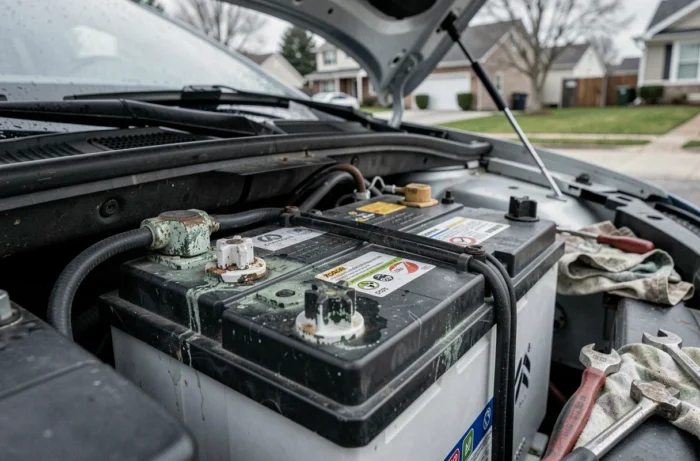
- The battery-chassis ground strap: check the condition of the terminals, the tightness, and the presence of green or white corrosion at the connections
- The engine-chassis strap (often fixed between the block and the frame): it frequently breaks or corrodes on high-mileage C3s
- The connectors of the alternator control line: a poor contact on the control wire is enough to generate an intermittent charging fault
- The positive terminal of the battery and the power cable to the starter/alternator: an abnormal resistance on the positive circuit also distorts the regulation
Cleaning and tightening these connections resolves the issue in a significant proportion of cases, without the need for parts replacement.
Smart Battery Sensor and Energy Management on C3
Some versions of the C3 integrate a smart battery sensor (IBS, Intelligent Battery Sensor) mounted directly on the negative terminal. This sensor measures in real-time the voltage, current, and temperature of the battery to power the vehicle’s energy management system.
When this sensor drifts or fails, the control unit receives inconsistent data. It can then trigger energy-saving mode and cause the battery warning light to flash, even when the vehicle is stationary. The switch to Eco mode (cutting off certain consumers, limiting air conditioning) is a strong indicator of this failure.
Replacing the IBS sensor requires a diagnostic tool to teach the control unit to recognize the new component. A simple exchange without re-learning often leaves the fault active.
Differentiating an IBS Issue from an Alternator Fault
Confusion between these two failures is common. A faulty alternator causes abnormally low or high voltage with the engine running. A faulty IBS sensor displays inconsistent current or temperature values in the data frames, while the voltage measured with a multimeter remains correct.
Reading the parameters in real-time via the diagnostic tool clarifies the issue within minutes.
Accessory Belt and Alternator: Mechanical Checks
Purely mechanical causes remain possible and should not be ruled out. A loose or glazed accessory belt slips on the alternator pulley, especially at low revs or when stationary with active consumers. The warning light then appears intermittently.
On the 1.4 HDi C3, the accessory belt also drives the power steering pump and the air conditioning compressor. A seized tensioner pulley alters the belt tension and reduces the alternator’s drive.
Common alternator failures include:
- The internal regulator (short-circuited or broken rectifier diodes) causing unstable output voltage
- Worn brushes, common beyond high mileage, causing intermittent contact with the collector
- The front bearing of the alternator, whose seizing leads to heating and a gradual decrease in efficiency
We observe that on HDi C3s, replacing the alternator alone does not always resolve the flashing issue if the electronic control or ground fault has not been addressed beforehand.
Recommended Diagnostic Sequence
To avoid unnecessary replacements, we recommend following a precise verification order. Starting with reading the fault codes with the diagnostic tool allows for immediate direction of the diagnosis towards the control circuit, the IBS sensor, or the alternator itself.
Next, measure the battery voltage with the engine off, then with the engine running at idle and during acceleration. A stable voltage between 13.8 and 14.4 V with the engine running rules out an alternator fault. Check the grounds, then the wiring of the control line if the fault codes point to the LIN network.
A flashing battery warning light at rest on a C3 does not necessitate replacing the battery as the first reflex. In the majority of cases we handle, the fault lies upstream: electronic control, corroded ground, or faulty IBS sensor. Making the correct diagnosis before ordering parts saves time and limits costs.