Planning easy and quick meals for each day of the week involves measuring what really holds you back: available time, number of ingredients, cost per serving. A study by Appinio for LSA published at the end of February 2026 reveals that 30% of French workers have less than 30 minutes for lunch, including the break.
The classic restaurant now accounts for only about 10% of lunchtime meals. Faced with these constraints, everyday recipes must be judged on measurable criteria, not on vague promises of simplicity.
Preparation time, ingredients, and cost: comparison by type of quick meal
Not all so-called “quick” dishes are created equal. A chicken stir-fry with vegetables and a lentil soup do not require the same time or budget. The table below compares five categories of easy meals based on three concrete criteria.
| Type of meal | Average preparation time | Number of ingredients | Estimated cost per serving |
|---|---|---|---|
| Express pasta sauce (oil, garlic, cheese) | 10-15 min | 4 to 5 | Very low |
| Chicken or beef stir-fry with vegetables | 15-20 min | 5 to 7 | Moderate |
| Mixed salad (protein, starch, raw vegetables) | 10-15 min | 5 to 8 | Moderate |
| Soup or lentil dahl | 20-25 min | 5 to 6 | Low |
| Wrap or filled flatbread (salmon, cheese, vegetables) | 10 min | 4 to 6 | Moderate |
Pasta and wraps have the shortest preparation time. On the other hand, mixed salads require more chopping and ingredients, which lengthens preparation time without considering cooking time.
To find ideas suited to what remains in the fridge, tools like keskejmets.fr allow you to start with available ingredients rather than a theoretical recipe, which reduces both decision time and waste.
Batch cooking and weeknight meals: the real time gaps
Batch cooking has evolved from a niche trick to a mass practice. In the fall of 2026, Cyril Lignac’s show “Tous en cuisine” dedicates a specific format to weekly meal preparation in a single session. The stated goal: save time, limit waste, and maintain balanced homemade meals.
The gap between cooking every evening and preparing in batches can be measured concretely. Cooking a quick meal each day takes between 10 and 25 minutes each evening, or about 70 to 175 minutes of active cooking per week. A batch cooking session condenses this time into one to two hours on Sunday, freeing up almost all weeknight evenings.
What batch cooking changes for everyday meals
The difference is not just in total time. It also affects daily mental load. Choosing a recipe, checking ingredients, getting out utensils: these micro-tasks repeated every evening weigh more than the cooking itself.
Batch cooking works particularly well for three categories:
- Base sauces (tomato, curry, cheese) prepared in quantity and spread over several meals throughout the week
- Plain cooked proteins (grilled chicken, ground beef, poached salmon) that can then be integrated into a salad, pasta, or wrap
- Roasted or sautéed vegetables in large quantities, usable cold or reheated
On the other hand, dishes that lose texture when reheated (fried foods, puff pastry, poached eggs) do not lend themselves to this method. Batch cooking does not replace daily cooking; it absorbs the repetitive part.
Quick meals from leftovers: the underestimated variable in the fridge
Most content on weeknight meals starts from a planned shopping list. In reality, a significant portion of quick dinners relies on what remains in the fridge by mid-week.
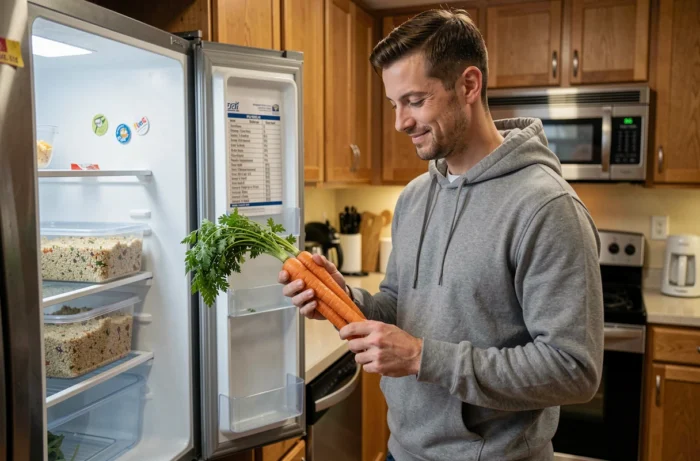
A leftover roast chicken from Sunday, some leftover rice, a few half-used vegetables: these elements form the basis of quick meals as long as you master a few assembly techniques. A leftover stir-fry in a wok takes less than 10 minutes and only requires a splash of oil, soy sauce, and a basic starch.
Three effective assemblies with common leftovers
- Fried rice: leftover rice + fridge vegetables + egg + soy sauce. Actual time: 8 minutes in a hot pan
- Express soup: leftover cooked vegetables + broth + spices (curry, paprika). Blend and serve in under 15 minutes
- Meal salad: leftover protein (chicken, salmon, beef) + green salad + cheese + dressing. No cooking required
These assemblies do not appear in classic recipe lists because they do not have a fixed name. However, they represent a significant portion of meals actually consumed during the week.
Quick recipes and nutritional balance: what express formats sacrifice
A meal prepared in under 15 minutes tends to favor starches (pasta, bread, potatoes) at the expense of vegetables, which require washing, peeling, and cutting. Vegetables are the first item sacrificed when time is short.
A few adjustments can correct this imbalance without extending preparation time. Frozen pre-cut vegetables cook in 5 minutes in a pan or microwave. Bagged salads, although more expensive, eliminate all preparation. Canned legumes (lentils, chickpeas) provide plant proteins and fiber without any cooking.
The trap of ultra-quick recipes also lies in the reliance on industrial sauces to compensate for reduced cooking time. A homemade vinaigrette (oil, vinegar, mustard) can be prepared in 30 seconds and is a better substitute for a packaged sauce.
Adapting your weeknight meals to real time constraints does not mean giving up homemade cooking. The majority of workers are looking for solutions under 30 minutes.
At this stage, the key remains to reduce decision time as much as cooking time: start with what you have, master three or four assembly techniques, and accept that a good weeknight dinner does not need to resemble a magazine recipe.