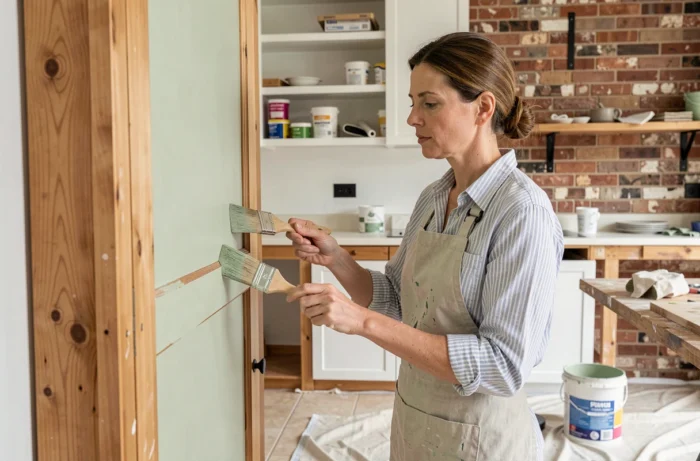
A project to transform an interior or a garden relies on technical decisions before it becomes a matter of taste. Choosing a covering, modifying a partition, or restructuring a flowerbed involves knowing the regulatory constraints, the properties of materials, and the local climatic conditions. The most useful DIY, decor, and gardening tips are those that avoid costly mistakes, not those that are limited to a visual effect.
Prior declaration and urban planning: the legal framework before construction
Most content dedicated to outdoor decor jumps straight to layout ideas. They overlook a prerequisite: some outdoor works require urban planning permission. A garden shed, a raised terrace, a low wall, or a change in facade appearance may require a prior declaration or even a building permit.
The triggering threshold depends on the area created, the height of the structure, and the local urban planning plan (PLU) of the municipality. The rules differ depending on whether the plot is located in an area covered by a PLU or not. Checking with the town hall’s urban planning department remains the reflex to adopt before any material purchase.
Another overlooked point: the verification of underground networks. As soon as a project involves excavation (foundation of a low wall, planting a large-caliber tree, laying buried curbs), anti-damage regulations require consulting the single window for networks. This step also concerns individuals hiring a company. Ignoring it exposes one to damage to gas pipelines or electrical cables.
Finding all the content from Brico Déco Jardin allows for a deeper exploration of each type of project with its specific constraints, from the living room to the fence.
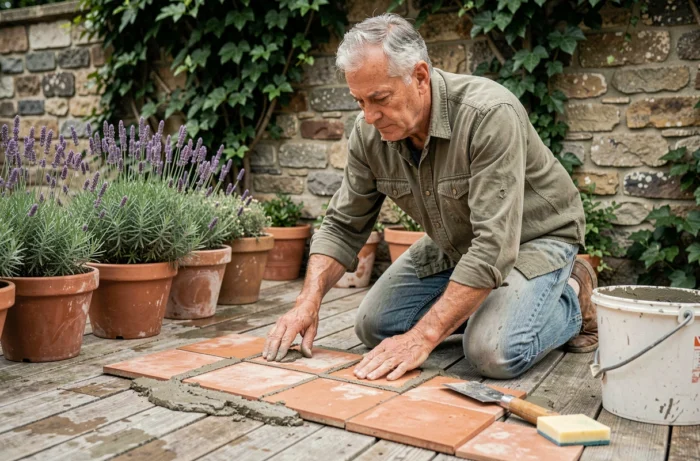
Revamping a piece of furniture or a room: choosing the right material rather than the right color
The usual reflex is to select a trendy color and then look for the corresponding paint. The reverse approach yields better results: start with the support, identify its nature (raw wood, melamine, metal, plaster), and then choose the appropriate product.
- On melamine or laminate, standard acrylic paint adheres poorly. A specific adhesion primer is necessary before any coloring, or it risks peeling within a few months.
- On old varnished wood, a light sanding with fine grain followed by a blocking primer prevents tannin bleed that yellows light shades.
- On an old plaster wall, directly applying a decorative coating without a primer causes blistering. The primer stabilizes the porous support and regulates absorption.
Revamping a piece of furniture starts with diagnosing the support, not with a color chart. This logic also applies to living room furniture, shelves, and door frames.
When DIY reaches its limits
Some interventions seem simple but require precise know-how. Stripping an old piece of furniture covered with several layers of paint may reveal lead in the deep layers. In this case, chemical stripping without precautions disperses toxic particles. A quick test with a lead detection kit, available at large DIY stores, can help make a decision.
Garden and biodiversity: designing for the climate, not against it
Repeated heatwaves and droughts in recent years are changing the design criteria for a garden. Planting water-demanding species in well-draining soil exposed to full sun leads to constant maintenance and frequent losses. Adapting to the local climate becomes a design criterion, not just an adjustment of watering.
Choosing drought-resistant plants (lavenders, ornamental grasses, yarrow, sedums) reduces water consumption and maintenance time. A thick organic mulch limits evaporation and nourishes the soil as it decomposes.
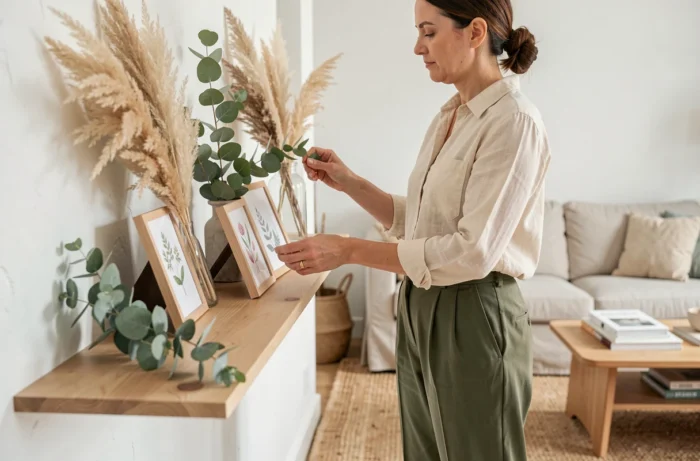
Differentiated mowing and refuge zones
A garden mowed short across its entire surface impoverishes auxiliary wildlife. Differentiated mowing involves allowing certain strips or peripheral zones to grow freely while maintaining circulation and living spaces at a standard height. This practice encourages pollinators and natural pest predators (ladybugs, lacewings).
Keeping a pile of dead wood in a corner, leaving fallen leaves under a hedge, or installing a small water point transforms a decorative garden into a functional ecosystem. These actions cost nothing and reduce the use of phytosanitary products.
Interior decoration: balancing style and furniture durability
A low-cost piece of furniture replaced every two years ends up being more expensive than a quality piece kept for ten years. The cost per year of use is the most reliable criterion for deciding on a furniture purchase, whether it’s a living room sofa, a table, or a dresser.
Particle board covered with decorative paper deteriorates quickly due to moisture or impacts. A solid wood or quality plywood piece withstands moves, sanding, and successive repainting. The structure of the furniture determines its ability to be revamped in five or ten years.
Colors and natural light
In a poorly lit room, saturated shades (duck blue, fir green) absorb light and visually shrink the space. A base of light walls combined with colorful touches on furniture or textiles helps maintain brightness while adding character. Dark colors work well in through rooms or those with large openings.
The final detail that changes the perception of a room without touching the walls or furniture: the color temperature of the bulbs. Warm light is suitable for living spaces and the living room, while a more neutral light improves visual comfort in a workshop or kitchen workspace.
Transforming your interior and exterior starts with understanding materials, the regulatory framework, and environmental conditions. A well-prepared project, even modest, lasts longer than a spectacular layout built on fragile foundations.