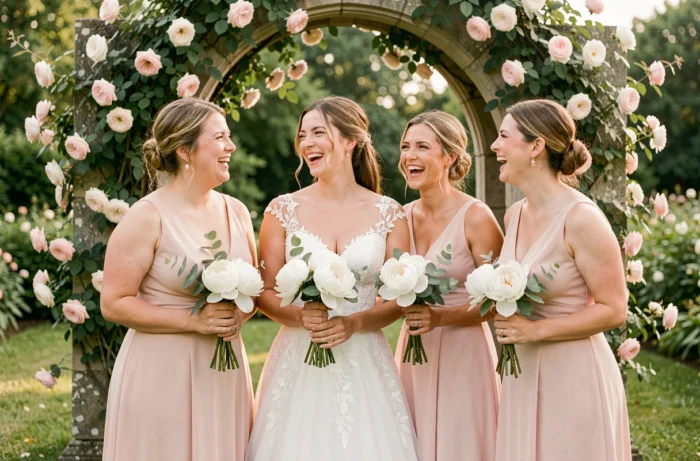
The term “bridesmaid” spontaneously evokes a single, young woman surrounding the bride on the big day. The question of whether a married woman can hold this role regularly comes up in forums and discussions among friends and family. To answer this, it is necessary to distinguish between what falls under legal framework, tradition, and current social usage in France.
Civil witness and bridesmaid: two roles not to be confused
The confusion between witness and bridesmaid fuels a good part of the misunderstandings. However, these two functions do not have the same status or obligations.
| Criterion | Civil witness | Bridesmaid |
|---|---|---|
| Legal basis | Civil Code (mandatory signature of the act) | None, purely social usage |
| Authorized number | 2 minimum, 4 maximum per marriage | Free, at the bride’s choice |
| Marital status condition | No restrictions | No restrictions |
| Typical missions | Sign the act, sometimes read a text at the town hall | Help with preparations, bachelorette party, logistical support, procession |
| Combination of both roles | Possible in the same marriage | |
The only role regulated by law is that of civil witness, whose mission is limited to attesting to the union before the civil registrar. No legal text mentions the role of bridesmaid. Everything related to the procession, the organization of the bachelorette party, or moral support falls under social usage, freely defined by the couple.
This is why the question of whether a married woman can be a bridesmaid finds a clear legal answer: nothing prohibits it.
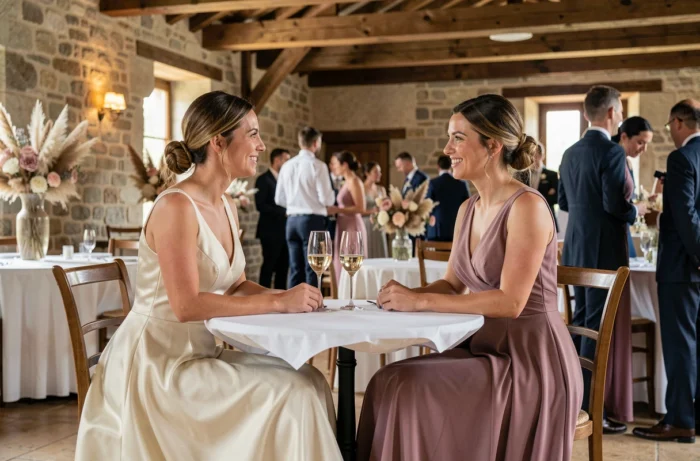
Origin of the tradition: why the word “bridesmaid” poses a problem
In French, “demoiselle” historically referred to an unmarried woman. This old meaning has created a persistent linguistic reflex. In Anglo-Saxon tradition, there is indeed a distinction between “maid of honor” (single) and “matron of honor” (married). In France, this distinction has never been codified.
The origin of the bridesmaid procession dates back to Roman antiquity and the Middle Ages. The women accompanying the bride were dressed similarly to deceive the supposed evil spirits threatening the union. The marital status of these companions did not come into play: only the similarity in attire mattered.
Over time, the superstitious dimension has disappeared. The role has become emotional and logistical. The word “bridesmaid” has remained out of habit, but it no longer conveys any requirement of singleness.
Combining roles on the wedding day: what works and what doesn’t
On paper, a married woman can be a bridesmaid, a civil witness, or both at the same time. In practice, certain configurations require clarity between the couple and the person involved.
What works without difficulty
- A married friend who participates in the procession, wears the coordinated outfit, and accompanies the bride during preparations. Her wedding ring does not change her organizational capacity or her presence on the big day.
- A married sister who combines the role of civil witness and bridesmaid. She signs the act at the town hall, then joins the procession for the religious or civil ceremony.
- A close friend who has recently organized her own wedding and brings concrete experience with vendors, budgeting, and logistics.
Points of friction to anticipate
Tensions do not arise from marital status but from mental load. The role of bridesmaid involves significant availability during the months of preparation: scouting locations, coordinating with vendors, organizing the bachelorette party, managing unforeseen events on the day of the ceremony.
A married person with young children or a tight schedule may struggle to invest as much as someone more available. Honesty upfront avoids disappointments. It is better to have a clear discussion about real expectations than to have unspoken issues that turn into grievances.
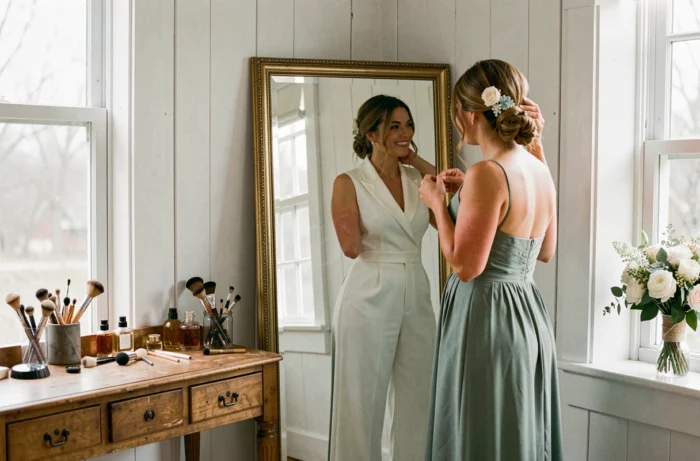
Wedding etiquette in France: freedom takes precedence over protocol
Contemporary French etiquette guides do not mention any restrictions related to marital status for joining a procession. The choice of bridesmaids is based on trust and emotional closeness, not on civil status.
The only criterion that matters is the relationship between the bride and the chosen person. A long-time friend, a cousin, a colleague who has become a confidante: the personal bond takes precedence. The spouse of the married bridesmaid is simply invited among the guests, without any particular role to fulfill.
On the other hand, the question of attire deserves attention. Group photos gain coherence when the procession wears coordinated outfits. The choice of bridesmaid dress does not depend on marital status but on the dress code defined by the couple. A married woman wears the same outfit as the other members of the procession.
Some brides also choose to replace the term “bridesmaid” with a more neutral designation: “ceremony witness,” “honor attendant,” or simply the first name. This detail, seemingly trivial, avoids awkward remarks from those present on the day of the ceremony.
The French wedding allows couples a wide margin of maneuver to compose their procession. Neither the law, nor current tradition, nor social conventions condition the role of bridesmaid to singleness. The only determining variable remains the actual availability of the person and the quality of the bond that unites them to the couple.